Text and images by Gabriele Mastrilli
Travelling through Namibia means crossing landscapes that seem to belong to other planets.
Namibia is a place where the desert is not simply sand or rock, but an arena of extreme contrasts, deafening silences and a beauty that forces you to slow down until you eventually come to a complete stop. It is not about conquering peaks or covering kilometres, but about learning to move through a space that strips you back to your most essential self. As soon as you arrive, a strange feeling takes hold of you. The rush, the speed and the constant urge to do and see things cannot exist here. Time is not measured in hours and days, but in horizons and kilometres.
The dunes of Sossusvlei rise like frozen waves of red and orange, hundreds of metres high and shaped by the wind over thousands of years. Walking along their ridges at dawn means sinking into the cool sand as the sun paints impossibly long shadows. Every step demands effort, but rewards you with a breathtaking view: a sea of sand stretching endlessly beneath an almost unreal blue sky. Moving among these shapes feels like walking through something alive. Early in the morning, before the wind has erased everything, the sand tells stories: delicate insect tracks, narrow grooves left by snakes, and the light footprints of oryx and jackals. These animals move when the heat briefly relents, perfectly adapted to conditions that remain extreme for us. Survival here is not a spectacular struggle, but a precise balance. Conserving energy, choosing the right moment to move and making use of every available resource. Nothing is wasted.
Not far away, the rocky Namib Desert greets you with a different kind of harshness. Stones, low mountains and canyons carved out of seemingly nothing surround you, while vegetation is reduced to a handful of sparse and stubborn survivors. It is an essential, almost abstract landscape, where light plays with shadow to create palettes of ochre, black and terracotta. There is no shelter here. The heat of the day and the biting cold of the night remind you that you are only a temporary guest.
In Namibia, water is almost always invisible. It does not flow or gather. It exists as moisture and as fog drifting in from the ocean, penetrating only a few kilometres into the desert. Some plants and animals have learned to survive within it. They collect tiny amounts of water from the air, turning something imperceptible to us into a tangible means of survival. The human body changes too. After days of walking, you learn to drink differently, to manage your energy and to recognise the signs of fatigue before they become a problem.
What truly strikes you, however, is neither the heat nor the effort. It is the space. In Namibia, space has a physical weight. It surrounds you, moves through you and confronts you with a dimension you cannot control. There are no landmarks and no obvious boundaries. Only lines, wind and distance. At first, it is disorienting. Then, slowly, something begins to change. You start to let go of everything unnecessary: in your movements, your thoughts and your expectations. Only the essentials remain. Your steps, your breath, your direction. It is a form of simplification that has nothing romantic about it. It is simply necessary.
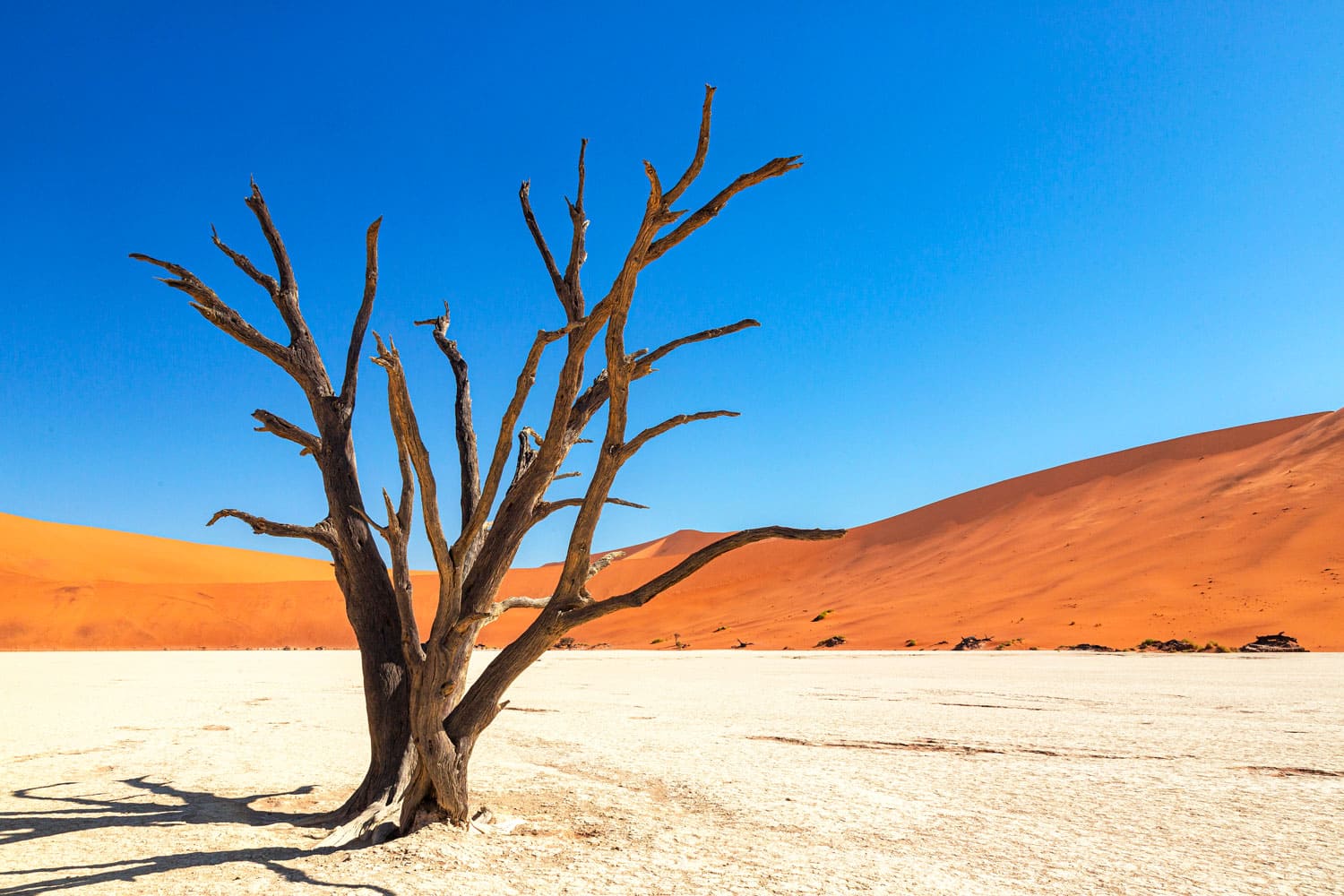
The most intense moment comes at Deadvlei. A basin of cracked white clay, where the skeletons of ancient acacia trees stand black and twisted against the red dunes. They have not fallen and they have not decomposed. They have remained there, motionless and darkened by the sun. There is no movement and no sound. Only contrast: the white earth, the black trunks, the vivid orange of the dunes and the deep blue of the sky. The silence is absolute, broken only by the sound of my footsteps and the wind shifting grains of sand.