

TEXT BY IVAN PERI
When Sergio (Sergio Pezzoli, ed.) suggested climbing Mount Ararat in late summer, I couldn't help but accept without hesitation. A name that evokes biblical events and atmospheres like Ararat couldn't leave me indifferent. In fact, aside from childhood reminiscences I'd heard in catechism, I had trouble pinpointing its location on the map.
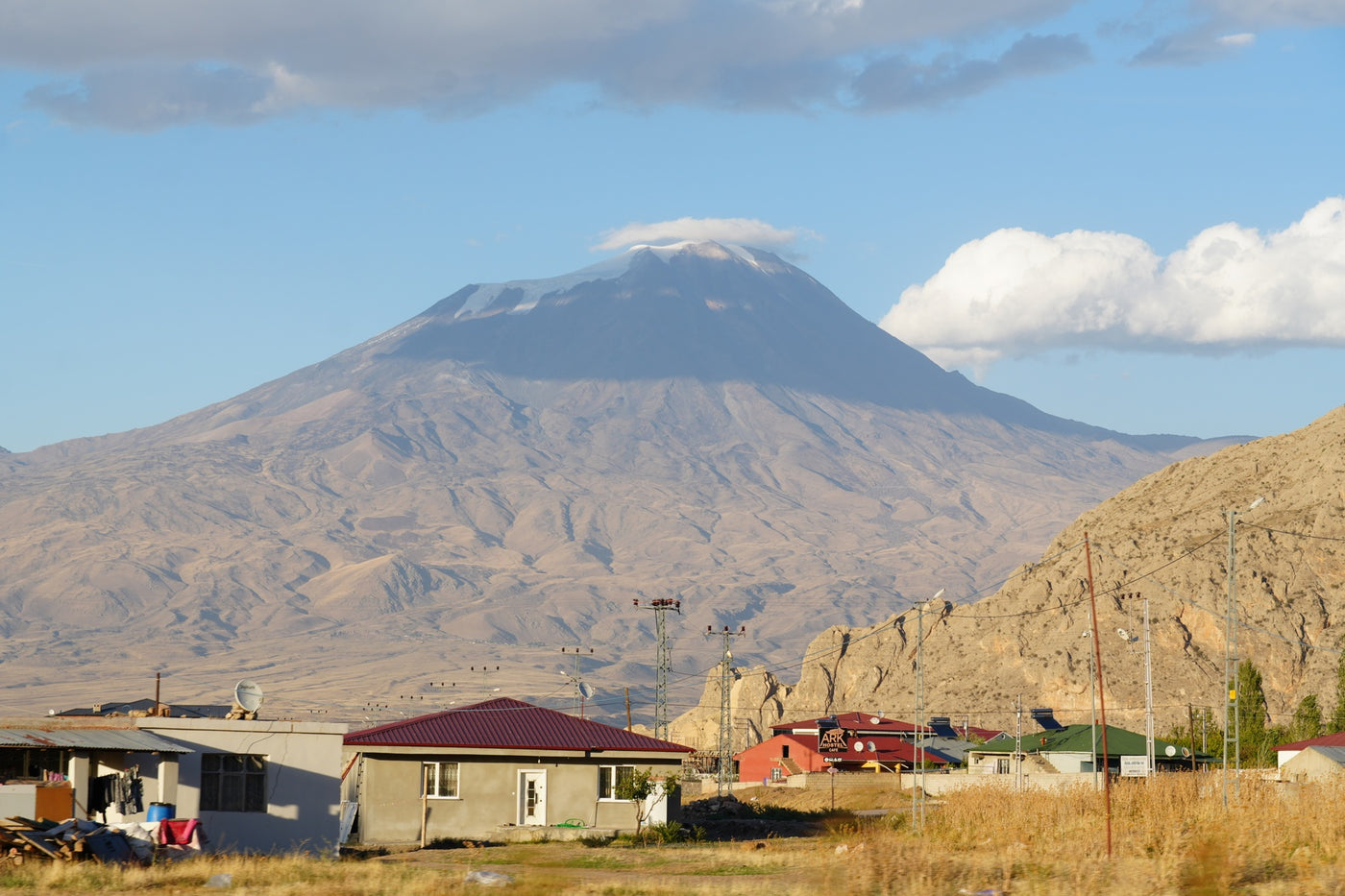
Far east of the Turkish plateau, just a few kilometers from the Iranian border and about thirty kilometers from the Armenian border. The name Ararat is in fact Armenian and comes from the Bible, while in Turkish it is called Agri Dagi (mountain of sorrow). The surrounding environment is arid, typical of the Middle East, almost desert-like in places. The mountain is large, imposing, and elegant; it towers and characterizes the entire plateau, dominating it with its white summit cap, a beautiful and unusual glacier in a desert environment. I'll leave the entire trip organization to Sergio; you can trust his meticulousness with your eyes closed; I barely managed to carve out these six days for a whirlwind trip.


As soon as we disembarked from the plane, we immediately immersed ourselves in our adventure, transferring to Dogubeyazit where we slept, and the next morning we immediately set off by jeep to the slopes of Mount Ararat to walk to Camp 1. It was hot, and we set off enthusiastically, wearing light footwear—me in my tried-and-tested, very blue Rocket DFS GTX, comfortable yet safe on the mixed terrain of burnt earth and dark, smooth lava rocks. The camp was rather deserted; it was now the end of the season, and much of it had already been dismantled. The atmosphere was peculiar, a mix of abandonment and disorder; unfortunately, cleanliness was not the norm in these parts, and trash was often found strewn about. Most of the tents had already been dismantled, leaving only skeletons: iron tubes lined up in more or less neat rows and small, somewhat makeshift cubicles that served as bathrooms. The camp was spread out on a sunny bank at the foot of the peak, always clearly visible with its pure white. Around, we see only a few local workers busy, fumbling around inconsistently between cigarette breaks. Toward evening, before the pink and reddish lights of sunset come on, we see the only two small groups of hikers descending from Camp 2. Our kitchen tent reflects the end-of-season atmosphere; only the cook and our guide are there, along with two of the guys who were working in the camp. We imagine and hope that during the season, things will be a little more organized, clean, and tidy, but we're not so sure. We don't care, though; we're here solely to enjoy the climb, and this unusual emptiness only pleases us. Sergio and I have spent a season surrounded by people; we need a break. Having great difficulty communicating with our guide, who doesn't speak a word of English, we sense that the weather unfortunately isn't promising for the day after tomorrow, the day we've planned for the summit. We know it's a bit risky to ask to do it tomorrow. We've already cut the days to the limit to climb this peak, which is usually organized over several days, climbing up and down the camps to acclimatize. But we only have this one chance, and in any case, we feel good. We have some experience at altitude, so we confidently ask if we can't aim for the summit tomorrow and return to Camp 2 for the night. We're granted permission, and so we raise our eyes and are already focused on the 1,800-meter steep climb that will take us to the summit tomorrow.


We set off in the morning, energized and enthusiastic after a cold night in the tent. The climb gradually becomes steeper and steeper. The path is more or less even, but the view becomes more expansive and breathtaking as we ascend. We reach Camp 2, already at 4,200 meters. We put on our winter clothes and then, with satisfaction and curiosity, slip on our new Croda DFS GTX boots. I hadn't tried them yet, but I know from experience that they're immediately comfortable and adapt to the shape of my foot. They're lightweight, ideal for this technical terrain with lava rocks that almost completely cover the ground, but they're also solid and safe on my ankles. The Croda DFS GTX will be especially useful for the final stretch toward the summit, when we'll be using crampons. We climb at a shorter pace than this morning: the altitude is making itself felt, and we're short of breath. When it's finally time to set foot on the ice, our favorite element, the cold wind blows hard. We don't waste time in breaks or chats except for a few photos of the glacier that descends from the summit and of one of its tongues now submerged by debris: we are on the southern side and unfortunately the loss of thickness, movement and strength of the glacier is evident here too.
As we continue wordlessly toward the summit, a cloud begins to envelop it, and when we finally reach the summit, unfortunately, we can only briefly enjoy the breathtaking view that this gigantic monolith in the middle of an arid plateau offers on clear days. We want to stop, but the wind freezes us, and the sky will only cloud over as the minutes go by... So, a few ritual photos, then we turn on our heels and, full of satisfaction, we set off again down to where the wind eases. The descent is quick, and we pass it with smiles for the beautiful climb in an environment so different from our usual Alpine surroundings, but also for the calm, peace, and solitude of this place. In fact, we were alone all day; only late in the morning did we meet a small group of five people returning. We walk in silence, each lost in their own thoughts, gradually more tired but increasingly satisfied at having achieved our goal.


We arrive at Camp 2 feeling a bit tired, and we try to get something to eat, without much success. There's no one left at the camp, and around 5:30 PM we crawl into our sleeping bags in the only remaining tent, more to rest than to sleep. Sleep was impossible: the strong wind, the altitude, the fatigue, and our heavy, pounding heads.
In the morning, however, we're in a good mood; a day of relaxation and rest awaits us at Camp 1, in the surreal atmosphere of the deserted camp. In fact, we're alone with five Turkish workers. They let us have lunch with them out in the open next to what should be one of the kitchens, a ruin built of stone, wood, and tarpaulins. They've grilled chicken and some vegetables on a makeshift fire right there on the ground: everything is simple and authentic, and it probably couldn't have been better for the two of us. With the camp packed, we wouldn't have enjoyed it so much! We rest, let the clothes dry, and sort out our gear for tomorrow's departure. We take a few photos of the eagles and vultures that often thermalize here on the shores of Mount Ararat, and await the magical colors of the sunset. Shortly after sunset, the large Caucasian shepherd that had been wandering around the camp during the day begins to glare angrily and incessantly at the wolves and other animals that populate the surrounding area, and doesn't stop until dawn.
In the morning, the atmosphere is magical, a bit like the Wild West: the landscape with its warm, arid colors, the expanses that spread out beyond the slopes of Mount Ararat instill calm and unwind the mind. I enjoyed every dusty step of this return journey; a few details give character to every glance: free-roaming horses, small plants with thorny leaves, low lava stone walls, I believe created by shepherds to shelter their goats and sheep... it all seems beautiful to me before returning to the chaotic world of men down in the sprawling city of Dogubeyazit.
It was an intense and diverse four days, almost surreal. A unique place, a mythical mountain rising from the plateau to over 3,600 meters, one of the highest peaks in the world, reaching over 5,100 meters where ice nestles in the middle of the desert.
Thanks to AKU for the footwear, always effective, comfortable and reliable, and to my partner Sergio for suggesting this wonderful adventure.
AKU Ambassador Ivan Peri


